Businesses across Canada depend on electric motors for manufacturing, automation, HVAC systems, pumps, conveyors, compressors and many other industrial processes. When equipment requires accurate speed control, smoother operation or greater process flexibility, a Variable Frequency Drive (VFD) can provide an effective motor-control solution.
For businesses searching for VFD Canada, Variable Frequency Drive Canada, VFD Supplier Canada or Industrial VFD Canada, selecting the right drive requires more than checking the motor horsepower.
Motor specifications, load characteristics, operating conditions, control requirements, communication systems and technical support can all influence the final selection.
This guide explains how VFDs work, where industries use them, what to consider before buying one in Canada and how to compare leading VFD brands for industrial applications.
What Is a VFD?
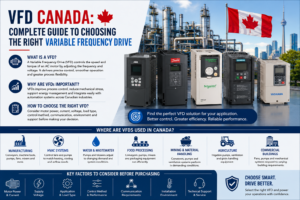
A Variable Frequency Drive, commonly called a VFD, is an electronic device that controls the speed and torque of an AC motor.
Unlike a motor connected directly to a fixed-frequency power supply, a VFD can regulate the frequency and voltage supplied to the motor. As a result, the motor can operate at different speeds according to the requirements of the application.
A typical VFD contains several important sections:
AC input
Rectifier
DC bus
Inverter
Control electronics
Motor output
Communication and control interfaces
The drive processes incoming electrical power and produces a controlled output for the motor. Therefore, users can adjust motor operation according to changing process requirements.
How Does a Variable Frequency Drive Work?
A VFD first converts incoming AC power into DC power. The inverter then converts that DC power back into controlled AC output.
The output frequency determines the motor’s operating speed. Consequently, the drive can increase or reduce motor speed within the limits of the motor and application.
For example, a pump may not require full-speed operation throughout the day. In that situation, the VFD can reduce motor speed when demand falls and increase it when the system requires greater flow.
Modern drives can also support different control methods, including:
V/Hz control
Sensorless vector control
Closed-loop vector control
The right method depends on the application’s performance requirements. Basic V/Hz control may suit some fans and pumps, while demanding machinery can require more advanced control.
Why Are VFDs Important in Canada?
Canadian industries operate across many applications and environments. Manufacturing facilities, warehouses, commercial buildings, water systems, agricultural operations and processing plants can all have different motor-control requirements.
A VFD gives equipment greater flexibility by allowing motor speed to respond to changing process demands.
Variable Motor Speed
Instead of running continuously at one speed, a motor can adjust its operating speed according to process requirements.
For instance, a conveyor may need different speeds during various production stages. Similarly, a pump can change speed according to flow demand.
Controlled Acceleration
A VFD can gradually accelerate a motor instead of applying full operating speed immediately. This approach can reduce sudden mechanical stress during startup.
As a result, connected components such as motors, couplings, belts and gearboxes can experience smoother operating conditions.
Controlled Deceleration
Controlled stopping can also benefit machinery that should not stop abruptly.
For example, gradual deceleration can help reduce sudden mechanical loads on conveyors, pumps and other rotating equipment.
Improved Process Control
Variable speed operation allows equipment to respond more closely to actual production requirements.
Therefore, operators can adjust motor speed according to factors such as flow rate, airflow, material movement or production speed.
Potential Energy Savings
VFDs can provide energy-saving opportunities in suitable variable-torque applications.
For example, reducing the speed of a centrifugal pump or fan when full output is unnecessary can lower the power required by the system. However, actual savings depend on the motor, load profile, operating schedule and overall system design.
Automation Integration
Modern VFDs can integrate with PLCs, HMIs, SCADA platforms and other automation systems.
Depending on the model, communication options can support better monitoring, control and integration within an industrial automation network.
Where Are VFDs Used in Canada?
VFDs support motor-driven equipment across many Canadian industries. Their applications range from manufacturing and HVAC to water treatment, agriculture and material handling.
Manufacturing
Manufacturing facilities use VFDs for conveyors, machine tools, pumps, fans, mixers and other motor-driven equipment.
Variable speed control allows production machinery to operate according to changing process requirements. In turn, manufacturers can improve operational flexibility.
HVAC Systems
Heating, ventilation and air-conditioning systems commonly use variable speed drives for fans and pumps.
The drive can adjust motor speed as heating, cooling or airflow requirements change. Consequently, HVAC equipment does not always need to operate at maximum speed.
Water and Wastewater
Water and wastewater facilities use VFDs for pumps and blowers.
Variable speed operation can help equipment respond to changing water demand and system conditions. Proper sizing remains important for reliable operation.
Food Processing
Food processing plants may use VFDs for conveyors, pumps, mixers, packaging equipment and other machinery.
The selected drive should match the motor, machine requirements and operating environment.
Mining and Material Handling
Mining and material-handling facilities can require motor control for conveyors, pumps, ventilation systems and other heavy-duty equipment.
Because these applications may involve demanding loads, engineers should evaluate torque, overload capacity, duty cycle and environmental conditions before selecting a drive.
Agriculture
Agricultural operations can use VFDs for irrigation pumps, ventilation systems, grain handling equipment and other motor-driven machinery.
Adjustable speed control allows equipment to respond to changing operating requirements.
Packaging
Packaging machinery often requires accurate and repeatable motor operation.
A VFD can provide adjustable speed control for suitable machine components. Therefore, manufacturers can adapt equipment speed to different production requirements.
Commercial Buildings
Commercial buildings may use variable speed drives for fans, pumps and other mechanical systems.
The drive can respond to changing building requirements while providing greater control over motor operation.
How to Choose a VFD in Canada
Searching for VFD Canada can produce many products and brands. However, the correct drive should match the motor and application rather than simply the lowest price.
Before selecting a model, review the following factors.
1. Check the Motor Power
Start with the motor’s rated power.
Depending on the manufacturer and application, motor specifications may appear in horsepower or kilowatts. Nevertheless, power alone does not determine the correct VFD size.
2. Check Motor Current
Motor current is another important selection parameter.
Two motors with similar horsepower ratings can have different current requirements. Therefore, always check the motor nameplate before choosing a drive.
3. Confirm Supply Voltage
The available electrical supply must match the VFD input requirements.
Canadian installations can use different electrical configurations depending on the facility and application. For this reason, confirm the actual site supply before purchasing a drive.
4. Consider the Application Type
Different machines place different demands on a motor.
For example, a centrifugal pump does not have the same requirements as a conveyor, compressor or high-inertia machine.
Evaluate the following characteristics:
Starting torque
Overload requirements
Acceleration time
Deceleration time
Required speed range
Load characteristics
Control method
Duty cycle
Understanding the application makes VFD selection more accurate.
5. Select the Right Control Method
Different applications require different levels of motor control.
Depending on the VFD, available control methods can include:
V/Hz control
Sensorless vector control
Closed-loop vector control
Basic applications may work well with V/Hz control. On the other hand, demanding machinery may benefit from more advanced vector control.
6. Check Communication Requirements
Automation systems often require the VFD to communicate with a PLC, HMI or SCADA system.
Before purchasing the drive, verify the required communication protocol and network interface. This step can help avoid compatibility problems during installation.
7. Evaluate the Installation Environment
The operating environment can influence VFD performance and service life.
Consider factors such as:
Temperature
Humidity
Dust
Vibration
Enclosure requirements
Ventilation
Cooling requirements
Available installation space
For industrial facilities, these conditions can be particularly important when selecting the appropriate drive.
Buy VFD Canada: What Should You Consider?
If you plan to buy a VFD in Canada, avoid making the decision based only on the initial purchase price.
Instead, consider the complete value of the drive, including compatibility, reliability, installation requirements, technical support and future maintenance.
Before requesting a quotation, prepare the following information:
Motor voltage
Motor current
Motor horsepower or kW
Motor frequency
Load type
Required speed range
Starting requirements
Stopping requirements
Overload requirements
Communication requirements
Installation environment
Technical support requirements
Spare parts availability
Replacement options
Providing complete motor and application information can make the selection process faster and more accurate.
VFD Supplier Canada: Why Technical Support Matters
A VFD Supplier Canada can provide more than the drive itself.
For industrial applications, technical support can assist with drive selection, configuration, troubleshooting, replacement and application requirements.
A reliable supplier should understand the motor and application before recommending a model.
Important Support Services
A VFD supplier may provide:
VFD sizing
Application evaluation
Product selection
Technical documentation
Programming assistance
Installation guidance
Commissioning support
Troubleshooting
Replacement-drive selection
Spare parts support
For critical industrial machinery, this level of assistance can help reduce unnecessary downtime.
VFD Distributor Canada: What to Look For
A VFD Distributor Canada can give businesses access to products from different manufacturers.
Instead of comparing drives based only on brand or price, an experienced distributor can evaluate the actual motor and application requirements.
A suitable drive should provide the right balance of:
Performance + Compatibility + Reliability + Support
This approach becomes especially important when the equipment plays a critical role in production.
Industrial VFD Canada: Applications and Selection
An Industrial VFD Canada solution may need to operate continuously in demanding environments.
Industrial applications can involve:
High motor loads
Frequent starts and stops
High ambient temperatures
Dust or moisture
Heavy inertia
Continuous operation
Rapid speed changes
High starting torque
Therefore, VFD selection should consider the actual duty cycle and load characteristics.
A drive that performs well with a light-duty fan may not provide the same results on a heavy-duty conveyor. For that reason, application-based selection is essential.
Popular VFD Brands in Canada
Several international manufacturers provide VFD solutions for industrial automation and motor-control applications.
The ideal brand depends on the motor, application, control architecture, communication requirements and available technical support.
ABB VFD Canada
ABB VFD Canada solutions are used across industrial motor-control and automation applications.
rovides drive families for different applications and power requirements. When evaluating an ABB drive, consider motor specifications, load characteristics, control requirements and system integration.
Danfoss VFD Canada
Danfoss VFD Canada products support applications such as HVAC, pumps, compressors and industrial processes.
Provides application-focused drive solutions for different motor-control requirements. Therefore, the selected model should match the equipment and operating conditions.
INVT VFD Canada
INVT VFD Canada products can support various industrial and commercial motor-control applications.
Different product families offer different capabilities. As a result, businesses should select the model according to the motor and application rather than power rating alone.
Delta VFD Canada
Delta VFD Canada solutions are used in industrial automation and machinery applications.
Provides different drive series for applications with varying motor-control, automation and connectivity requirements. Consequently, the appropriate model should match the specific machine and control system.
Fuji VFD Canada
Fuji VFD Canada solutions are available for industrial motor-control and automation applications.
Provides drive products for different machinery and industrial requirements. Before selecting a model, review the motor specifications and application characteristics.
Yaskawa VFD Canada
Yaskawa VFD Canada products are used for industrial motor-control and automation applications.
Offers different drive families for different application requirements. Therefore, model selection should focus on load characteristics, control performance and motor specifications.
Allen Bradley VFD Canada
Allen Bradley VFD Canada solutions include PowerFlex drive families used in industrial automation environments.
For facilities using Rockwell Automation systems, compatibility with the existing PLC and automation architecture can be an important consideration.
Schneider VFD Canada
Schneider VFD Canada solutions include the Altivar range of variable speed drives.
Provides drive solutions for applications such as:
Pumps
Fans
Conveyors
Compressors
Machinery
Industrial automation
The correct Altivar model depends on the motor, load and application.
Mitsubishi VFD Canada
Mitsubishi VFD Canada products are used in factory automation and industrial motor-control applications.
When selecting a Mitsubishi drive, consider the motor, machine, control requirements and automation architecture together.
Siemens VFD Canada
Siemens VFD Canada solutions are commonly used in industrial automation and motor-control environments.
Provides drive solutions for different applications, from general motor control to advanced industrial systems. As a result, selection should reflect the specific technical requirements of the project.
Omron VFD Canada
Omron VFD Canada products can support machine automation and motor-control applications.
For automation projects, communication compatibility between the drive and existing control equipment should be reviewed before purchase.
How Do You Compare VFD Brands?
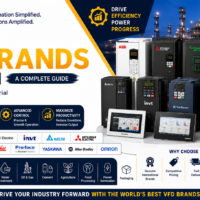
Choosing between ABB, Danfoss, INVT, Delta, Fuji, Yaskawa, Allen-Bradley, Schneider, Mitsubishi, Siemens and Omron should begin with the application.
Rather than focusing only on brand reputation, compare each solution using practical technical criteria.
Motor Requirements
Check the motor’s:
Voltage
Current
Power
Frequency
Speed
Load Characteristics
Identify whether the application uses a:
Pump
Fan
Conveyor
Compressor
Mixer
High-inertia machine
Other industrial load
Control Requirements
Determine whether the machine needs basic speed control or more advanced torque and speed regulation.
For demanding applications, advanced control can provide better performance.
Automation Integration
Check whether the VFD needs to communicate with a PLC, HMI, SCADA system or industrial network.
Compatibility should be confirmed before selecting the final model.
Environmental Conditions
Consider whether the drive will operate indoors or in an environment exposed to:
Heat
Dust
Moisture
Vibration
Other challenging conditions
Service and Support
Finally, evaluate the technical assistance available after purchase.
Good support can simplify commissioning, troubleshooting, maintenance and future replacement.
VFD Replacement in Canada
Replacing an old VFD is not always as simple as purchasing another drive with the same horsepower rating.
Before replacing an existing model, review:
Existing VFD model
Motor nameplate
Motor current
Input voltage
Application
Existing control method
PLC interface
Communication protocol
Physical dimensions
Installation arrangement
Required overload capacity
A modern replacement may also provide improved communication, monitoring and diagnostic capabilities.
However, compatibility should always be verified before installing a replacement drive.
Can a VFD Reduce Energy Consumption?
A VFD can contribute to energy savings when the application allows motor speed to decrease according to system demand.
This benefit is particularly relevant to variable-torque applications such as centrifugal pumps and fans.
For example, a fan that does not need to operate at full speed continuously may consume less power when its speed decreases.
However, actual energy savings depend on several factors, including:
Motor efficiency
Load characteristics
Operating profile
System design
Control strategy
Operating schedule
Therefore, evaluate the VFD as part of the complete system rather than treating it as an automatic energy-saving solution.
Common VFD Selection Mistakes
Choosing a drive without considering the complete application can create operational problems.
Here are several common mistakes to avoid.
Selecting Only by Horsepower
Horsepower provides useful information, but motor current and application requirements also matter.
Ignoring Overload Requirements
Heavy-duty machines may require greater overload capacity than light-duty applications.
Choosing Without Checking Communication
Automation systems may require specific communication protocols. Always verify compatibility before purchase.
Ignoring Environmental Conditions
Heat, dust, moisture and vibration can affect drive installation and performance.
Choosing the Cheapest Product
The lowest purchase price does not necessarily provide the lowest total cost of ownership.
Consider reliability, support, maintenance and replacement availability as well.
Not Considering Technical Support
Critical machinery may require troubleshooting, programming or replacement assistance. Therefore, supplier support can be an important part of the purchasing decision.
Why Choose Vision Controls for VFD Solutions?
Selecting a VFD should begin with the application rather than the product price.
Vision Controls can help businesses evaluate their motor-control requirements and identify suitable VFD solutions for industrial and automation applications.
Whether you want to buy a VFD in Canada, replace an existing drive or source an industrial motor-control solution, providing accurate motor and application information is the first step.
Vision Controls can assist with:
VFD selection
Industrial motor-control solutions
Drive replacement
Application-based product selection
Technical guidance
Automation requirements
Industrial VFD solutions
Looking for a VFD in Canada?
If you are searching for a VFD Supplier Canada, need an Industrial VFD Canada solution or want to compare VFD options from leading manufacturers, Vision Controls can help you identify a suitable solution based on your application requirements.
Contact Vision Controls today to discuss your motor-control requirements and find the right VFD solution for your application.
Frequently Asked Questions About VFDs in Canada
What Is a VFD?
A VFD, or Variable Frequency Drive, is an electronic motor controller that regulates the speed and torque of an AC motor by controlling the frequency and voltage supplied to it.
How Do I Choose the Right VFD in Canada?
Start with the motor nameplate information, including voltage, current, horsepower or kW and frequency.
Next, evaluate the application, load type, overload requirements, required speed range, communication needs and installation environment.
Where Can I Buy a VFD in Canada?
Businesses can purchase VFDs through industrial automation suppliers and distributors.
Before purchasing, provide the supplier with complete motor and application information. This allows the supplier to identify a more suitable model.
What Is the Difference Between a VFD Supplier and a VFD Distributor?
The terms are sometimes used interchangeably.
A supplier provides access to the required product, while a distributor may represent or distribute products from specific manufacturers. Depending on the business, a distributor may also provide technical and commercial support.
Which VFD Brands Are Available in Canada?
VFD solutions are available from manufacturers including ABB, Danfoss, INVT, Delta, Fuji Electric, Yaskawa, Allen-Bradley, Schneider Electric, Mitsubishi Electric, Siemens and Omron.
Availability can vary by supplier and product family.
What Information Is Needed to Select a VFD?
Useful information includes:
Motor horsepower or kW
Motor voltage
Motor current
Motor frequency
Motor speed
Application type
Load characteristics
Required speed range
Overload requirements
Communication requirements
Can a VFD Be Used With a Pump?
Yes. VFDs are commonly used with pump systems where variable motor speed can help control flow or pressure.
However, the drive and pump system should be correctly sized for the intended application.
Can a VFD Be Used With a Fan?
Yes. Fans are common VFD applications.
Variable speed control allows airflow to change according to demand. In suitable systems, this approach can also reduce energy consumption.
Can VFDs Save Energy?
VFDs can reduce energy consumption in suitable applications, particularly variable-torque loads such as centrifugal fans and pumps.
Actual savings depend on operating conditions and overall system design.
How Often Should a VFD Be Replaced?
There is no universal replacement interval.
Service life depends on factors such as operating temperature, electrical conditions, load, installation environment and maintenance.
Replacement may become necessary because of failure, obsolescence or the need for improved functionality.
Final Thoughts
Finding the right VFD in Canada requires more than comparing product prices.
The motor, application, load profile, operating environment, control requirements and automation system all influence the final drive selection.
Whether you are searching for VFD Canada, Variable Frequency Drive Canada, Buy VFD Canada, VFD Supplier Canada, Industrial VFD Canada or VFD Distributor Canada, start with the technical requirements of your application.
ABB, Danfoss, INVT, Delta, Fuji, Yaskawa, Allen-Bradley, Schneider, Mitsubishi, Siemens and Omron all offer VFD solutions for different applications.
With proper technical evaluation and supplier support, businesses can select a drive that fits their motor-control requirements and long-term operational goals.
Looking for VFD solutions in Canada? Contact Vision Controls to discuss your application and VFD requirements.